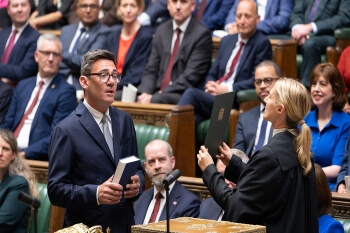
As Andy Burnham prepares to enter Downing Street, Localis chief executive Jonathan Werran asks whether his premiership will finally unlock genuine tax-raising powers for local government – or whether Treasury orthodoxy will once again win out.
Well that escalated quickly. With the fevered internal logic and speed of a Latin American telenovela storyline, Andy Burnham has transitioned from Greater Manchester Mayor to prime minister presumptive and the door of Number 10 will be his to enter on 16 July.
Already we are getting a sense of the economic advisers he is to surround himself as well as some symbolic and significant acts to assert regionalism under the brand of ‘Manchesterism’. Expect some Monday announcements on a Number 10 for the North in Manchester and other surface baubles.
Behind the scenes, one of two dominant influences will be Lord Jim O’Neill, the former Goldman Sachs analyst turned Treasury Commercial Secretary and Northern Powerhouse champion is a known fan of borrowing to fund pro-growth infrastructure.
The second is Sir Andrew Haldane, the former Bank of England chief economist and co-author of the Boris Johnson administration’s Levelling Up White Paper. Intriguingly, for Haldane the coda for Levelling Up was that despite the intellectual rigour of the case for devolution, the agenda was holed below the waterline before the ship set sail on account of the Treasury’s blank stare refusal – possibly understandable given the recent timing of the ruinous pandemic bailouts – to grant anything like the scale funding or discretion for fiscal devolution a programme of this national ambition to reduce economic geographic inequality would require.
The question is whether Burnham's premiership and leadership will finally open the door to genuine tax-raising powers for local government, or will Treasury orthodoxy and hard-wired institutional instincts win out? For Localis, and other long-term champions who view fiscal devolution as the key to solving the perennial economic underdevelopment and stalled post-war productivity crisis, all those years spent advocating and writing seem a triumph of perseverance against the stacked odds. We haven’t been banging our heads outside Horseguards Avenue in vain all those years, after all.
In the recent context, the current chancellor Rachel Reeves’ announcement of a roadmap for fiscal devolution to be announced at the autumn Budget has already set expectations high.
There is an expectation that this time it will be different. The advisory team of O’Neill and Haldane can set the tone, but the next chancellor will set the direction. Here we will have to wait and see which of the bigger beasts from the Labour front bench Burnham will turn to as his neighbour at No 11 Downing Street. Clearly, the fear of reviving the TBGBs – signifying the dire dysfunctional interdependency of Blair and Brown’s relationship – will haunt and guide this vital choice.
If Burnham puts his faith in Ed Miliband, would this put the programme into top gear immediately? Or would say a trained economist like front bench stalwart Yvette Cooper get with the programme more than a managerial Pat McFadden? We will have to wait and see how political dynamics advance or retard the agenda.
Intriguingly also, the MHCLG will be moving out of its shared digs with the Home Office in Marsham Street to return to its original home in the Treasury building. Here the dynamic between senior officials and the alignment between granting tax-raising powers with the Burnham growth agenda will have to be factored in. The chances of a deep and meaningful roadmap for fiscal devolution will depend on the strength of ministerial authority and support and the ability of senior civil servants to provide the connective policy between other fiscal changes in areas like land value tax of which Burnham is a champion.
Having overcome entrenched resistance from the Treasury to allow a visitor levy, the floodgates could open to localised income tax, there could be all to play for. However, a few sense checks would be in order.
The current Treasury roadmap is designed to be fiscally neutral, so although the virtue of spending locally-raised revenue is in play, it won’t be a casino. Geographically, and following on from the Fair Funding 2.0 outcome, there will be other means of fiscal irrigation that brings more money flowing to the north and midlands. And there will be renewed fears from MPs representing coastal, rural and commuter belt seats, that this form of ‘Levelling Oop’ will be seen by their voters as a highway ‘stick-em-up’ in which money from the prosperous parts of the country – which including their share of deprived communities – is diverted to Labour’s threatened heartlands.
As it stands, only London, the South East and Eastern regions of England put more money into the exchequer’s coffers than they take out in welfare and other costs. Replacing council tax with an aforementioned land value tax – which is a yearly charge based on a home’s market value – would impact the Greater South East where house prices have peaked higher, and business rates reforms would be of greater worth to companies in areas like the north and midlands where commercial property prices are cheaper.
In our most recent report, ‘Everything in its right place’, Localis recommended the benefit of adopting a universal fiscal devolution roadmap for all emerging strategic authorities, not just the established mayoral strategic authorities, and to signpost avenues for exploring further reform – including greater devolution of revenue-raising powers to national levies such as income tax or VAT.
Fiscal devolution has to be seen to be working for all four corners of the land. And finally, let’s remind ourselves that the fruits of fiscal devolution will accrue to strategic authorities in their endeavours to improve infrastructure, transport and pro-growth initiatives.
This won’t be money going towards the fixing of broken local public finances or the acute statutory service pressures that threaten to undermine our local authorities, on whose stability, as Andy Burnham acknowledged at the launch of his Makerfield campaign, depends the success of strategic regional government. It’s revenue spending as much as capital that makes all the difference.
Andy Burnham telling such home truths to Whitehall from the bully platform provided by the Great Northern Investment Summit was clearly most welcome back in May. But whether this programme will survive contact with the bond markets and harsh realities of public finances all the way to December may well prove another matter.