Helena Rivers, net zero lead at AECOM, argues that while appetite for climate initiatives may vary within central government, local authorities have the power to act now and drive a meaningful transition.
Recent forecasts from the UN expect global carbon emissions to rise by 10% by 2030, as opposed to the target of reducing levels by 43% set out in the Paris Agreement. We’re stoking the fire at a time when we need to rapidly accelerate the reduction of carbon emissions.
There are few local authorities that aren’t taking action to become more sustainable – many in the UK have already declared a climate emergency – but the resources to deliver complex, large-scale carbon reduction schemes are scarce, made even more so due to escalating costs for temporary accommodation hitting so many councils. This puts hopes of hitting net zero targets and the ability to deliver a more sustainable future in jeopardy.
It’s a similar scenario for many in the private sector – where some businesses lack the skills, financial muscle and appetite for risk to go it alone. Research included in our latest Future of Infrastructure report found that nearly half of businesses say that a lack of certainty around the potential returns are undermining their confidence to invest.
If we are to inspire the confidence needed to dedicate investment to large-scale projects, the public sector and the private sector will need to work hand-in-hand to share risk and resources.
Models for success
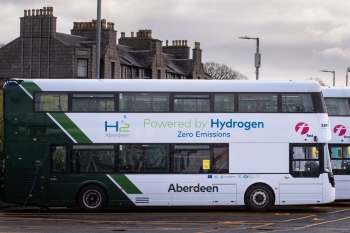
Fortunately, examples of how public/private partnerships have driven charge at scale aren’t short at hand. Aberdeen City Council (ACC) is one local authority that has recognised the risk of inaction and devised a plan to address it.
Green hydrogen power is expensive to produce and, understandably, energy providers are reticent to invest without assurances it will be in demand. So, ACC tackled this classic chicken-and-egg scenario with a public competition.
The council invited private companies to devise plans for green hydrogen production, and the winners were guaranteed that it would purchase the hydrogen produced from day one to power its new bus fleet. Suddenly, appetite to commit skills, funds and resources into a green energy transition was greatly increased.
The council also proposed a joint venture operating model with the competition’s winners. Sharing the risk – and responsibility – of pioneering green power is what will get schemes such as these off the ground.
Risk and reward share can be a challenging element in public/private sector partnerships. Open book accounting can often support building that trust between parties, where it may have previously been eroded due to past experiences, typically within private finance initiative (PFI) models.
Capitalising on central government funding will also help local authorities to smooth the path for the private sector to invest in new energy sources.
For example, the government heat network fund (GHNF) is helping accelerate the rollout of heat networks, which supply heat from a central source and deliver it to a number of buildings via a network of underground pipes. The heat source could be anything: a dedicated boiler, an otherwise wasted source of heat, a data centre, the sewers, or even our rivers and canals.
While not new, heat networks aren’t yet delivered at the scale required to turn the dial on making heat more sustainable in the UK. But the most recent funding from the GHNF is supporting the commercialisation and construction of the UK’s first-of-its-scale district heat network in London that will harness waste heat from the cooling of a number of data centres.
The heat network will connect over 9,000 new homes and 250,000m2 of commercial space, and span three London boroughs in the Old Oak and Park Royal Development Corporation area. It’s expected to deliver around 90GWh of heat across several phases between 2027 and 2040. But perhaps most importantly, it will act as a blueprint for how sizeable partnership models can deliver meaningful change for communities.
Government interventions have the potential to rapidly propel the energy transition – there are a growing number of examples to prove it. But we desperately need to go beyond examples and make large-scale energy infrastructure schemes attracting private sector funding the norm if we’ve any hope of hitting net zero by 2050.
And while appetite can sometimes vary within central government, local authorities have the power to act now and drive a meaningful transition.