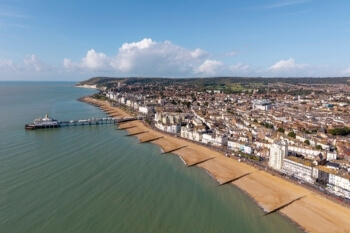
Only one in three coastal planning authorities in England have up-to-date policies in place to deal with rising sea levels and more frequent storms, the National Trust warns in a new report.
The charity’s research has also revealed that 12,500 new homes and businesses have been built over the last decade in coastal areas at risk of significant erosion or flooding, despite national guidance strongly advising against such developments.
The report, entitled 'Shifting shores – playing our part at the coast', outlines the National Trust’s recommendations for managing coastlines in the face of increasingly extreme weather conditions.
The conservation charity urges authorities to move towards an adaptation approach, based on an understanding of how nature works, and away from maintaining engineered defences.
Phil Dyke, the National Trust’s coastal marine adviser, said: ‘We know how difficult taking the adaptive approach can be, despite all the good policy guidance that now exists. But action is now needed by all coastal stakeholders to manage the threats to our beautiful and diverse coast to prevent us drifting into a future where our coast is a rim of concrete.’
The report also contains other recommendations:
• In order to aid coastal land management, buildings, infrastructure, shoreline and habitats should be rolled back.
• Large areas of the coast should be viewed as a whole in order to create more joined up and better managed stretches of coastline.
• Local landowners, communities and groups should be involved in coastal management.
Peter Nixon, director of land, landscape and nature at the National Trust, said: 'The complex and ever-changing challenges we face on the coastline can only be addressed by working in partnership with others. We can’t and won’t ever succeed on our own.
'Above all we need to understand the forces of nature at work, so that we can all make well-informed choices about whether and where to continue maintaining hard defences or to adapt to and work with natural processes.'