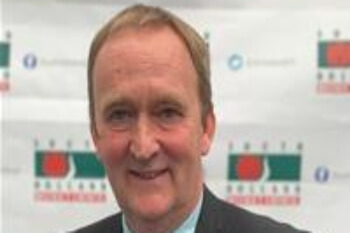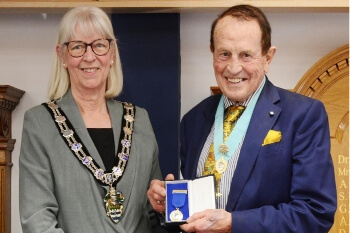
Cllr Dr James Walsh was elected to Arun District Council in 1975 – the same year Margaret Thatcher became Conservative leader. Fifty years, two mayoralties and countless budget cuts later, he tells LocalGov what he's learned about trust, transformation and keeping it local.
When Dr James Walsh was first elected to Arun District Council in 1975, he was a working GP among a chamber of mostly retired members. Five decades on – having served as council leader, twice as mayor of Littlehampton, and on West Sussex County Council since 1985 – he's watched local government transform almost beyond recognition. Earlier this year he was presented with a commemorative medal marking 50 years of service at Arun's Annual Council meeting.
LocalGov sat down with Dr Walsh to ask what's changed, what hasn't, and what today's councillors can learn from half a century in the chamber.
From amateurs to professionals
The biggest shift, he says, is the move away from local government as a part-time, almost amateur pursuit. ‘Everybody in it was a lot older than me,’ he recalls of his early days, when most members were retired. Now there are councillors who arrive ‘straight out of university’ and treat the role as a full-time occupation, alongside others – like Walsh himself was – balancing it with a career.
Training has improved too. ‘I can't actually remember any induction when I joined,’ he says. ‘And now there's full induction and training programmes for all new councillors.’ But he believes more support is still needed on casework – helping new members navigate confidentiality, when to seek legal or financial advice, and how much to take on for residents.
Trust is everything
Asked what makes local government function, Walsh doesn't hesitate: trust between officers and members, in both directions. He learned this the hard way in 1993, when his party unexpectedly took control of West Sussex County Council. ‘Officers hadn't seen it coming... it took a little while to actually build up that trust.’
That principle extends to cross-party relationships too. Walsh now sits in a formal coalition that he says works well – a contrast to the more guarded politics of a few years ago. However, he also warns, that ‘there's much less openness and trust than there was, say, 20, 15 years ago,’ even as he points to his own experience of building solid working relationships across party lines.
Keep it local
Having sat on parish, district and county councils simultaneously – what he calls being ‘triple hatted’ – Walsh has a clear view on the reorganisation debate reshaping councils across England. Residents understand and trust their town or parish council far more than the district, and even less the county tier, he argues. ‘I'm a great believer in keeping it as local as possible.’
Advice for the next generation
On financial pressure, his counsel is pragmatic: set priorities and focus on what's essential rather than the ‘frilly bits around the edge.’ For anyone considering standing as a councillor, his advice is to go in with open eyes. ‘It's not all as glamorous or as immediate as you might think it to be,’ he says – newcomers often expect to ‘change the world in a week.’ The role demands real preparation time beyond meetings themselves, consultation with colleagues and residents, and a willingness to ask officers for advice when unsure.
He adds one final, practical tip often overlooked: find out when and how often the council actually meets before you commit. ‘Taking the trouble to find out what the commitment is and the workload and the time is an important pre-investigation.’