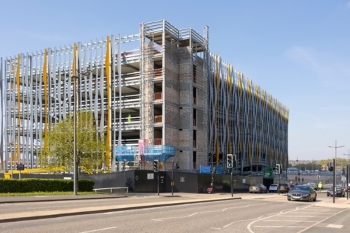
The oldest known car park was built in London in 1901 by the City & Suburban Electric Carriage Company. The seven-floored structure with space for some 100 vehicles no longer exists, but it’s interesting to discover in the Institution of Structural Engineer’s newly published Car Park Design guidance that the first parking buildings around this time were specifically designed to store and service electric vehicles (EVs).
Here in the 21st century, history is repeating itself with car parks yet again needing to become refuelling spaces alongside mere storage. The British Parking Association says there are approximately 17,000 local authority run car parks in the UK. Whether private or public, car parks have become a ubiquitous part of the built environment, with council’s playing a vital role in creating parking standards dependent on the type of building – whether commercial or retail.
New and extended guidance
But times are rapidly changing. Where to build a car park, its design and the materials used for that construction are huge decisions, ones that will become more complicated due to economic, social and environmental concerns about these structures and their use.
Given such pressures, getting the design right is essential. Our guidance explains that the structural design of car parks needs to be carefully considered to ensure they are fire-safe, sustainable and secure for public use.
The guidance’s scope has been widened, covering aspects of construction, maintenance, reuse, and demolition which impact on the initial design. Ten experts contributed to this wide-ranging publication. I was the overseeing consultant, while Mark Punsdack FIStructE expertly chaired the contributors group.
The guidance is in two parts: part one is aimed at those involved in procuring a car park, including clients, architects, and project managers among others. Part two covers more in-depth design issues, with comprehensive recommendations for those responsible for inputting to the detailed design such as structural and civil engineers.
The rise of the EV
Car Park Design spotlights an important consideration for car park design – the type of cars we drive now and those in the future. The push to all-electric cars is already placing extra demands on car parks. This will only increase as the UK will ban selling petrol and diesel cars and vans by 2030, and hybrid cars and vans by 2035.
The pace of change towards autonomous and semi-autonomous vehicles is also accelerating, and car parks will need to be designed to accommodate these too.
As a result, car park design needs to consider electric charging points, the parking bay sizes, and also the fact that e-bikes and e-scooters need to be stored and charged too.
The average vehicle’s gross weight has risen from approximately 1.5t in 1974 to almost 2t today and the maximum gross weight can be in excess of 3.0t – due to electric and hybrid batteries and the size of cars increasing. This extra load and the changing fire safety requirements are all considerations not just for new car parks, but for existing structures also.
Safety and accessibility
Car Park Design highlights that a number of serious fires have happened in car parks which were designed to current guidance, and that in certain circumstances, this may not produce a fire-safe design.
There are moral and legal duties to make buildings accessible for all — and car parks are no exception. Accessibility is an essential part of the design process, given that in the UK and many other countries people are living longer, with more independence. The physical impairments of a greater number of car park users therefore need to be addressed.
The safety and security of these buildings are paramount too, with the guidance dedicating a chapter to primary risks of car park design from slips, trips and falls to slippage to suicide where important considerations need to be given to the various physical measures that can be part of the building to deter suicide attempts.
Good practice
Car Park Design’s recommendations are intended to be set at a level of good practice. It does not set a gold standard, and a particular design may want to go beyond the recommendations made in this guide.
Conversely, standards and national regulations may give recommendations at a lower level. But this guide is intended to represent the state of-the-art, and to address changes to vehicles and use of car parking areas that other standards may not have considered.
The challenge for local councils responsible for existing car parks and for planning new ones are many: future proofing the structure, collaborating with all players in the design and construction process to ensure these buildings are, as our guidance says, fire-safe, sustainable and secure for all to use – now and in the future.
Chris Whapples is a structural and parking consultant with the Institution of Structural Engineers.
Sign up here to receive our free daily news and jobs bulletin.