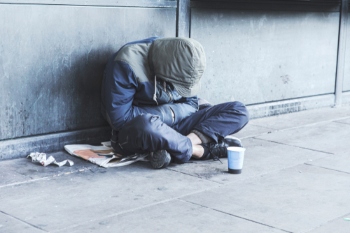
People who are experiencing homelessness are three times more likely to suffer from a long-term illness or disability when compared to the general population, new research reveals.
The new report from the charity Homeless Link has also found that homeless people are seven times more likely to have a diagnosed mental health condition.
The Unhealthy State of Homelessness 2022 report draws on data from 2,776 people experiencing homelessness, and reveals the stark levels of health inequalities faced by those without a home.
The charity found that 78% of those who responded to the research have a physical health issue, with eight in 10 of these experiencing more than one condition. Furthermore, 63% have a long-term illness, disability or infirmity compared to 22% of the general population.
Mental health conditions are experienced by eight in 10 respondents. This is compared to 12% of the general population who have a mental health condition2 and is up substantially from 45% since the data was last collated in 2014.
Almost three in 10 (27%) had not received a medical examination or treatment for a physical health condition when it was needed within the last 12 months, according to the report’s findings.
Half of respondents with a mental health issue would like more support to help them cope and recover and 45% of people self-medicate with drugs or alcohol to cope with their issue.
Shockingly, 45% of respondents were discharged from hospital onto the street or into unsuitable accommodation.
Rick Henderson, chief executive of Homeless Link, commented: ‘We know that “homelessness is a public health issue, not only a housing issue” and our research corroborates this, revealing the devastating impact of homelessness on health and wellbeing.
‘It is shocking to see that healthcare outcomes and access to support are universally poor for people experiencing homelessness – and that there is a sharp disparity when compared to the general population. We should not accept that because someone is experiencing homelessness, they have poorer health and receive poorer healthcare, and it is vital that we act to redress this.’
Mr Henderson added: ‘National and local governments must work to understand why health inequalities for people experiencing homelessness are increasing and why services remain unable to meet their needs. This learning must drive the systemic change needed to ensure that everyone receives the support they need to recover and remain well and are not left in circumstances known to worsen their health.’