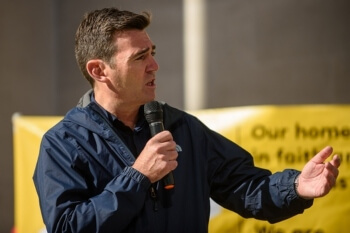
Andy Burnham's imminent arrival in Downing Street is being celebrated as a triumph of political skill. The real lesson, argues LGIU chief executive Dr Jonathan Carr-West, is that place – not personality – is the key to Britain's devolved future
It’s unwise to take anything for granted in British politics, but it now looks close to certain that Andy Burnham will become Prime Minister on July 17. Manchesterism is coming to Westminster.
But are we looking at this the wrong way round?
The proof of concept the Labour Party has taken from the Makerfield by-election was that Andy Burnham had the political skills to unite a fractured voter base, and that he is therefore the right man to lead them into the next election and to repeat this feat on a national stage.
But is this actually what the Makerfield by-election proves? An alternative hypothesis would be that his ability to do this is not just a function of Andy Burnham’s unique political skills (strong as these undoubtedly are), but that it is about place.
You can bring people together around place as an organising concept. What are the aspirations of the people who live here? What’s holding us back? What compromises are we willing to entertain? What trade-offs will we make? What sort of growth do we pursue? How do the people who live here now live peacefully and productively together? If Manchesterism is anything, it’s an answer to these sorts of questions. But the last two decades of British politics show us how hard it is to answer them at a national level.
A nation is too big, too diverse, too unequal for this to work. You can do Manchesterism, but you can’t do Englandism.
If that is the concept that Makerfield proves, then what follows from it is different. The conclusion then is not that you need to replicate Manchester at a national level, but that you need to create more Manchesters — not that you need a mayor to run the country (welcome though that may be), but that you need more mayors doing more things. You need to create more Manchester-style settlements backed up with real powers, real fiscal devolution, a real stake in national decision-making.
The big challenges we face as a country — growth, productivity, cohesion, public service reform — won’t be solved simply by changes of leadership in Westminster, but by doing more at a local level and less at a national level. That also frees up national leaders to do the things that only they can do, like defence and our place in the world.
It’s not about talent at the top; it’s about the structure of power. Mayor Burnham knew that. Let’s hope Prime Minister Burnham remembers this.
Early signs are encouraging. Burnham’s policy speech this week reflects exactly this argument. It’s possibly the most ambitious statement on devolution we have seen from a senior politician in a generation.
At LGIU, we have always argued that national success has local foundations, and that democratic control, economic growth and excellence in public services cannot be achieved by working from the top down, only nurtured from the bottom up. Burnham appears to understand this based on his remarks this morning.
The vision of a rewired Britain, with power genuinely shifted to places and communities, is one we have been making the case for - alongside our LGIU councils - since our Connected Localism work over a decade ago.
But vision requires a vehicle. We have seen ambitious visions before, and we have seen many governments come unstuck because of their failure to empower councils sufficiently.
Local government is the operational front line of the state, and right now it is hollowed out and close to collapse. Number 10 North, reindustrialisation, house building: none of this works without councils that have the capacity to deliver it.