There is now greater interest in the coastal and marine environment than ever before, reflecting appreciation of its current and potential economic, environmental and recreational importance.
This includes demand for developments that harness the natural resources of the sea, such as offshore renewables, or those in support of economically important industries such as tourism and aquaculture.
Our coasts and seas are also valued parts of our heritage. A recent National Trust survey found that 94% of people agreed with the statement that ‘it’s important to me that Britain’s coast is kept beautiful for future generations to enjoy’.
Until recently, our coasts and seas have been some of the least understood parts of the UK’s environment, with a lack of good information about their character and multiple values. By contrast, tools such as Landscape Character Assessment have been in place for many years to help local authority planners and developers understand the terrestrial landscape and how to reflect its importance in development proposals and decisions.
A consistent and robust means of understanding our seascape resource will help identify the best sites for development and make the process of deployment smoother, with fewer risks and uncertainties for investors, developers and local authority decision-makers.
Understanding seascape character
Put simply, seascape character assessment (SCA) is a systematic way of analysing and describing the character of coastal and marine areas. The process helps integrate the way we deal with marine and terrestrial areas by considering them in a holistic manner, rather than viewing them as separate entities.
It can be carried out at a number of different scales. Strategic assessments help inform high level planning policies and site selection exercises, while more local assessments inform scheme design as part of an Environmental Impact Assessment (EIA).
Taking account of factors such as inter-visibility and important cultural and natural heritage values, the technique maps and describes areas with broadly similar characteristics. Spatial analysis, backed by rigorous field surveys and stakeholder consultation, are essential parts of the process.
Applying SCA at strategic level
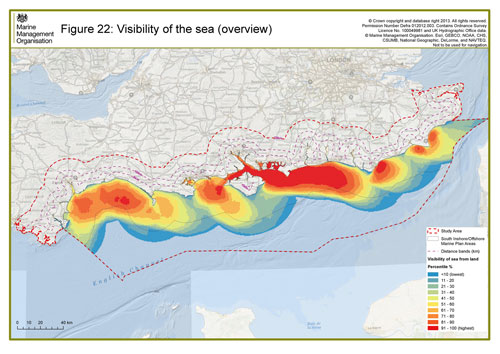 Map 1, taken from LUC’s Seascape Assessment for the South Marine Plan Areas shows how terrain modelling can be used to analyse views between the land and the sea.
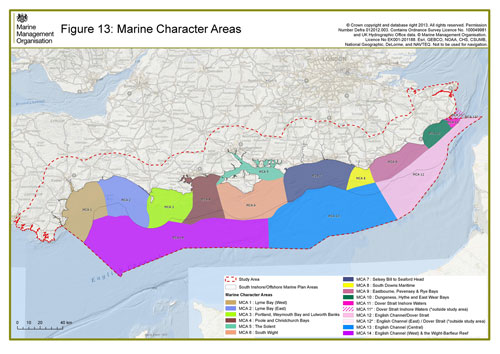 This helps with the identification and description of seascape character areas (Map 2), providing invaluable information to guide development and management.
Applying SCA at project level
SCA should also form a key part of the design and assessment processes at the project level, feeding into an analysis of environmental effects. It will explore the varying nature of the site’s coastline and sea, providing a baseline against which the effects of change, whether the introduction of renewable energy devices, or other types of development, can be judged. The use and interpretation of inter-visibility mapping helps with the analysis impacts, as well as in judging the likely impacts on ‘visual receptors’ (i.e. people).
A lead role by local authorities, followed by collaboration between the wider public and private sectors, is integral to a successful, interlinked coastal and marine planning system that helps meet the needs of everyone who lives, works or visits our diverse seascapes.
Sally Parker is from Land Use Consultants
Photo and maps: ©Land Use Consultants