Formed in the autumn of 2010 amid substantial financial challenges, the London tri-borough partnership has gone through multiple adaptations to become a highly influential pool of experience.
With cost cutting defined as a central aspect of the initiative at the outset, the unison of LB Hammersmith and Fulham, RB Kensington and Chelsea and Westminster City Council has achieved savings of £9.92m and is on track to exceed targets of £40m per year from 2015/16. In addition, the involvement of the united boroughs in a Whole Place Community Budget pilot has shown approximate net annual savings of £70m can be achieved across local public services within five years.
While the partnership grew from a desire for such savings, Sir Merrick Cockell, RB Kensington and Chelsea council leader, says extensive service improvements developed from this goal.
‘In the first year, we saw as our professionals started working together, got into the detail of it and looked at how each operates particular services, working together was not only being driven by financial reasons but was the answer to how you can deliver those better services and save money at the same time.
‘When you honestly and openly compared the three authorities, one of the three was doing something probably cheaper and probably better; if you apply that to the rest – and due to the scale and size of the three of us together – you could be having better outcomes and save money.’
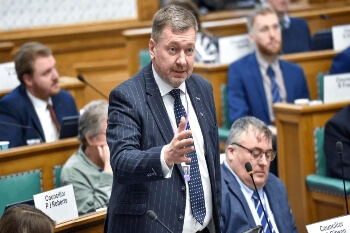
 Merrick Cockell says the influence of the tri-borough is 'far reaching'.
Exemplifying this combined focus on funds and improvement, responsibility for adult social care, libraries and children’s services have been shared across the boroughs.
Aid for families and young people has been directed through schemes including an employability passport, which is expected to boost jobs opportunities for 3,500 young people and annually generate £6-10m by 2015/16.
Delivery of the Government’s Troubled Families Programme has supported 1,720 families, while a cut in re-offending rates by 10% is expected to create £5m savings over five years.
Cllr Philippa Roe, Westminster City Council leader adds efficiency savings have been focussed on boosting quality in such areas.
‘We have stripped out layers of management and can focus on the front line staff, so improvements have been seen. We have been making sure to keep posts there rather than stripping them away and are looking for where we can join up.
 Philippa Roe said efficiency savings have also boosted the quailty of services.
‘The family recovery service has worked with 120,000 families across the borough. We have been able to focus on serious issues in the region, cutting violent youth crime by 61% last year – an outcome directly attributable to work in tri-borough,’ Roe says. Shared foster placements across the tri-borough and a reduction in the length of care proceedings to 28 weeks are also significant improvements, Cllr Nicholas Botterill, LB Hammersmith and Fulham council leader, says.
‘It is taking half the time to undertake legal proceedings for care services; I doubt one borough acting alone could achieve the same. ‘With things like adult social care, how we are going to town on care proceedings is quite a money saver through better practice,’ Botterill adds.
An integrated provision of health, social and community based adult care across the boroughs will assist the release of £38m in efficiencies at a local level by 2017/18, while a single library card system has enhanced the popular service. Botterill also emphasises upcoming health reforms will result in a ‘massive transformation’ which offers the tri-borough – and local government in general – a real ‘opportunity’ to revolutionise services.
‘There is the potential to re-engineer services to the population and do it in a new way which eluded the NHS.
‘The tri-borough will have a single director of public health and we will be pushing for innovation. Councils will inherit a lot of responsibilities and will have to take time to think: the emphasis should not be to replicate but to look at it all in the round.’
With plans for this improvement in place and two years of collaboration and improvement behind it, the tri-borough has become a force to be reckoned with. The Government agenda is now being influenced not only through the combined weight of the three boroughs but also by the example they are setting.
Arguing united organisations across the country are also showing the Government how to save and improve on services, Cockell says the influence of the tri-borough is far reaching.
‘If Government sees revolution, sees areas willing to take this risk, and sees evidence coming through that it’s working, you are going to be noticed. Our evidence extends beyond our part of London, beyond local government, actually it extends to the Government as a whole and government could be getting value from this.
‘When you reduce child care proceedings in half and lower the costs then that’s a pretty vivid story for any part of government.’
Indeed, Botterill says the examples provided by collaborating authorities reveal a need for non-legislative encouragement of local unity.
‘I don’t believe the model is suitable for top down legislation. Hammersmith and Fulham is working with West London boroughs in one group, central London for others, and the tri-borough. There need to be different options for what councils are dealing with as economic benefits could come with a different partner and a different dynamic.’
In light of the city deal extension in chancellor George Osborne’s budget, Cockell says the tri-borough is now contributing to calls for further localisation in budgetary shares and a move away from ‘whole city’ thinking.
‘What we have been saying is we are not a whole city, we are a significant part of a city. But we want our share, we want to make our bid to government to go further. Therefore, the Government has got to change some of its approaches to driving this localism forward.’
With this inter-city deal potentially on the horizon, what lies ahead for the tri-borough?
Roe suggests that thanks to growing awareness of the partnership, the trio might look to expand into sharing other service areas.
‘We’ve had a lot of interest from other councils and we need to look at what other services it would be appropriate to incorporate, assess what services we are already doing and whether these could be expanded to other public bodies or councils.’
Alongside addressing growing public health responsibilities, progress up to 2015 will see the tri-borough continue its redesign of human resources and finance systems. Expected to generate £6m in savings, a further 17 London councils have expressed an interest in joining this programme of work.
Two years on, the evidence of the tri-borough’s work remains undoubtedly impressive. However perhaps its most enduring legacy remains that the locally led partnership is not only regionally successful, but can push national thinking.