The Armed Forces Covenant (‘the Covenant’) is a promise by the Nation that the Armed Forces community – those who serve or have served, and their families – are treated fairly, and an acknowledgement of the unique challenges Service people and their loved ones face every day.
Underlying the promise of the Covenant are two principles:
• The Armed Forces Community – serving personnel, veterans and their families, should not face disadvantage compared to other citizens in the provision of public and commercial services
• Special consideration is appropriate in some cases, especially for those who have given the most such as the injured or bereaved.
Enshrined in the 2011-Armed Forces Act, the Covenant applies across the UK and the Government (HMG) has a statutory requirement to report annually to Parliament on its progress in upholding the Covenant.
HMG’s commitment to the Covenant was reinforced in 2017 with the creation of the Ministerial Covenant and Veterans Board with representation from the Devolved Administrations. Every department on the Board has appointed a lead Minister for Covenant issues.
Since 2011 much has been achieved and more remains to be done. Service families are being helped onto the property ladder with the Forces Help to Buy scheme which has awarded £267m (circa £15,000 per claim) to more than 17,800 successful applicants since April 2014.
In England, the Service Pupil Premium has provided funding to mitigate the impact of Service life on children’s education; since September 2018 enriched detail is available to teachers via the Common Transfer File on Service children’s educational needs and family circumstances.
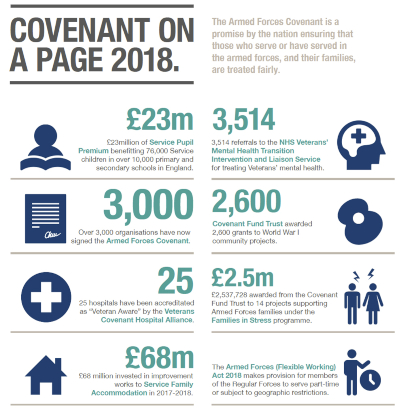 All 407 Local Authorities (LAs) in Great Britain have signed the Covenant, with bespoke arrangements in Northern Ireland.
Guidance is available to LAs on how they can most effectively support their Service populations, including using the £10M per annum Covenant Fund to build local partnerships between the Armed Forces and the wider community.
The partnership theme is also resonating in the private sector where support for the Covenant is growing rapidly, with more than 4,000 signatories to date. Companies are pledging support to military spouses, Veterans and Reservists by offering flexible HR policies and acknowledging the skills learnt during time in the Services. Further success has been achieved commercially, for example, companies agreeing to waive cancellation fees on media packages for those posted at short notice.
The Covenant is embedded in the NHS constitution and awareness in healthcare professionals of issues faced by the Armed Forces community is improving – the Covenant now forms part of the Royal College of GP’s membership exam and a growing number of GP practices are being accredited as ‘Armed Forces’ Veteran Friendly’.
Access to specialist prosthetics treatments and to mental healthcare services has improved significantly following the launch of the NHS’s Transition, Intervention and Liaison Services, and Complex Treatment Service.
However, much of what the Covenant has achieved so far stems from its voluntary nature. It is a pact between the Armed Forces community and the Nation in acknowledgment of the sacrifices they have made. The Nation honours this pact because it is the right thing to do, not because they are obliged to do so. None of this is meant to replace the Military Chain of Command’s and Services Welfare’s axiomatic pastoral roles, but the Covenant is part of a national tapestry of commitment to our people and a key component in creating resilience within the Armed Forces community.
A video on the Armed Forces Covenant ‘The Armed Forces Covenant in 60 Seconds’ is available at www.armedforcescovenant.gov.uk/sixty-second-covenant/