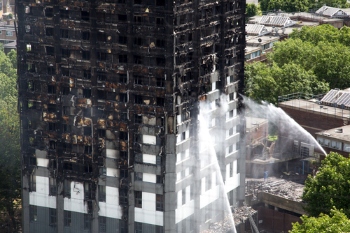
The Government has decided to reject a recommendation from the inquiry into the Grenfell fire which would require owners of high-rise residential buildings to prepare personal emergency evacuation plans for disabled residents.
In their response to the Personal Emergency Evacuation Plans (PEEPs) consultation, the Home Office said they were not proportionate or practical.
The campaign group Grenfell United said the Government had ‘decided that cutting costs is more important than the value of human life.’
In their response to the PEEPs consultation, the Home Office acknowledged concerns around implementing PEEPs in buildings with different fire safety strategies.
Some buildings have a ‘stay put’ strategy in place, while others require ‘simultaneous evacuation’ in the event of a fire. The Home Office argues it needs more evidence on the implications of implementing PEEPs in buildings with different policies.
The consultation also highlighted concerns about the availability of staff to enact PEEPs and the costs for leaseholders of implementing them.
‘We have given careful consideration to the general equality duty, but the concerns around practicality, proportionality, and the safety case have led us to conclude that mandating PEEPs as described in the consultation at this time could in fact have a detrimental effect on those with certain protected characteristics,’ the response concluded.
Responding on Twitter, Grenfell United said the decision had ‘left us speechless. Outraged.’
‘72 people died at Grenfell. 15 people had disabilities. They had no personal evacuation plans and no means of escape. Our loved ones did not stand a chance. Government failed them in every way,’ they said.
‘The report from Phase 1 of the Grenfell Inquiry was published in 2019. It concluded that the Government must drop its reliance on stay put and provide personal evacuation plans for disabled residents.
‘Today - three years on - the Government has announced it will not implement this core recommendation. They have decided that cutting costs is more important than the value of human life. We will not let this be brushed under the carpet.’
THREAD
— Grenfell United (@GrenfellUnited) May 18, 2022
1/5
For five years we’ve had to endure Government’s games. We’ve been forced to hold them to account to create a legacy of meaningful change for our loved ones. To prevent another Grenfell.
Today’s news has left us speechless. Outraged. https://t.co/5xb2Tj2px5
Council landlords were warned last month that they could face large legal claims for discrimination unless they put in place PEEPs for disabled tenants.
Legal advice to the Local Government Association (LGA) has suggested that existing case law based on the Equality Act 2010 seemed to place a responsibility on councils to plan for the evacuation of disabled residents by drawing up PEEPs.
The Home Office has launched another consultation on an alternative package of proposals known as Emergency Evacuation Information Sharing, which would require designated ‘Responsible Persons’ – individuals responsible for fire safety in their building – of the highest risk buildings to assess the needs of their most vulnerable residents and consider what might ‘reasonably be done to mitigate any risks to fire safety.’
A Home Office spokesperson said: ‘The Emergency Evacuation Information Sharing package we are consulting on would require those responsible for fire safety in higher risk buildings to properly assess the needs of the most vulnerable and take steps to mitigate any risks.
‘While the vast majority of buildings are completely safe we are determined to do more to improve fire safety, which is why these landmark reforms will ensure mid and high-rise blocks are properly assessed for fire risks.’