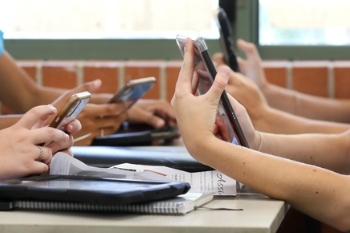
Over 100 hours a week is dedicated to enforcing smartphone policies at some schools, research has revealed.
The study in BMJ Mental Health is based on data from a nationally representative sample of 20 UK schools, 13 of which have restrictive policies and seven permissive.
According to the research carried out by academics from the University of Birmingham, schools with permissive smartphone policies spend an average of 108 hours on applying policies weekly, which serves as the equivalent of 3.3 full-time staff.
The schools with restrictive policies were found to dedicate 102 hours to the task, or the equivalent of 3.1 staff weekly.
While the staff working at schools with restrictive policies reported investing less time in monitoring phone-based activities and administrative tasks, they confirmed that more time is spent implementing ‘behavioural sanctions’ for phone policy contraventions.
Researchers also revealed that schools with permissive phone policies spend £94 more per pupil per school year compared to those with restrictive ones.
Furthermore, the study found that quality of life or mental wellbeing did not differ significantly between students attending schools with permissive or restrictive policies.
Professor Victoria Goodyear from the University of Birmingham and Chief Investigator of the SMART Schools Study said any phone policy is a ‘huge drain on a school to enforce’.
She added: ‘The high proportions of teacher time spent managing phone use or phone related behaviours during the school day is potentially being diverted away from other types of wellbeing promoting activities, such as pastoral support or extra-curricular activities.
‘We therefore need new ways of approaching adolescent smartphone use in schools.’
Professor Hareth Al-Janabi, Head of the Health Economics Unit at the University of Birmingham and a senior author of the study, added: ‘While there is a small difference in the resources needed to implement a restrictive policy, we are under no illusion that policing phone use is a big strain for schools and that a stricter policy is no silver bullet.’
.png)