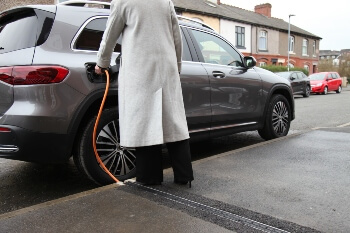
Blackburn with Darwen Council worked closely with manufacturer ACO to redesign cross-pavement EV charging infrastructure, tackling theft risk, kerb damage and installation time – and helping residents without driveways cut their charging costs by up to 90%.
For many residents, the biggest barrier to switching to an electric vehicle isn't cost or range anxiety – it's simply not having a driveway. In Blackburn with Darwen, around 26% of properties, roughly 15,462 homes, have no off-street parking, making at-home charging a genuine challenge rather than a convenience.
That reality shaped the borough's approach when it began trialling cross-pavement EV charging infrastructure with manufacturer ACO. Rather than simply testing a finished product, the council's highways team fed back directly on what worked – and what didn't – in real streets with varying pavement widths, footfall and vehicle overrun.
‘This had to work in the real world, on real streets, for real residents,’ the council explained. Metal covers, a common feature of early cross-pavement systems, raised an immediate concern: theft of metal assets is a known risk for local authorities, and any product placed in the public realm needed to account for that.
ACO responded by redesigning the cover entirely, switching to a durable recycled rubber material with an interlocking system that allows sections to function as one continuous cover. The change wasn't just about materials – it transformed day-to-day use. Residents can now lift the cover as a single piece, place their charging cable safely into the channel, and replace it quickly and easily. For installation teams, the redesign meant fewer cuts, easier connections, and a more consistent finished product, all while reducing the theft risk that metal covers had presented.
Protecting the highway asset
Beyond the cover itself, the trial also prompted a redesign of the end cap – the transition point between the pavement channel and the kerb. This detail mattered more than it might first appear. The kerb is part of the highway asset, and unnecessary cutting can compromise its integrity, creating future maintenance costs and problems.
.jpg) |
| ‘This had to work in the real world, on real streets, for real residents.’ © ACO |
ACO's system was designed to route the cable without cutting the kerbstone, protecting the highway and delivering a cleaner finish. The council also pushed for the end cap to withstand everyday street conditions, including being driven over by cars and delivery vehicles. It was strengthened so the channel sits more securely, improving alignment and long-term durability.
‘It is a good example of why councils should be involved early in product development,’ the council said. ‘Small design details can make a major difference to long-term performance in the highway.’
A genuine partnership
The council described the collaborative process with ACO as positive and constructive, with the manufacturer willing to adapt based on frontline experience rather than treating the trial as a standard product test. Its advice to other authorities considering similar trials is to get involved where possible, and to bring the right teams in early – highways, climate, legal, insurance, maintenance, accessibility and resident-facing services all have a stake in getting cross-pavement charging right.
Faster installs, real savings
The practical improvements have translated into measurable gains. Average installation time has fallen from around six hours to roughly four, with teams now able to fit two standard pavement channels in a single working day on straightforward sites. That efficiency has supported the delivery of 40 installations so far, with a further 140 subsidised channels planned across the borough.
The financial impact for residents has been significant. Public charging typically costs between 54p and 72p per kilowatt in the UK. One resident involved in the scheme reported that, since having a home charging system installed, he now pays just 5p to 7p per kilowatt to charge at his property – a saving of up to 90%.
Demand has followed. The council has received 322 applications and enquiries from residents interested in the scheme, reflecting appetite for charging solutions that don't depend on owning a driveway.
For Blackburn with Darwen, the project is about more than infrastructure. ‘The real measure of success is not just that we have trialled a new piece of infrastructure, but that residents are already telling us it has changed what is possible for them,’ the council said. By making at-home charging safer, simpler and more affordable, the scheme is removing one of the practical barriers to cleaner transport – and demonstrating how local authorities can help shape the market for products that work on ordinary streets.
Sponsored by ACO