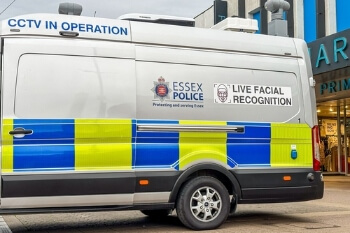
Tony Oliver, Head of Physical Security, North, explores how facial recognition technology, when deployed transparently and ethically, can help local authorities enhance public safety, support policing, and protect vulnerable communities, while addressing concerns around privacy, bias, and accountability.
In recent years, facial recognition technology has become one of the most debated tools in modern policing and public safety. To some, it represents a leap forward in protecting citizens and ensuring that missing persons can be found as quickly as possible. To others, it raises legitimate concerns about privacy, bias and the potential for misuse.
As with most new technologies, the truth lies somewhere in the middle ground, and understanding the true landscape of facial recognition technology starts with education and transparency.
Facial recognition is a biometric identification system that uses artificial intelligence (AI) to analyse facial features, such as the distance between the eyes or the shape of the jawline and create a unique mathematical representation of a person’s face. This unique ‘faceprint’ is then compared against a specific watchlist, which could include individuals wanted for arrest, missing persons or those subject to court orders. Contrary to some public perceptions, this is not a system that scans or stores data on the public. Every deployment must have a lawful and proportionate purpose.
There are three main forms of facial recognition technology used in the UK. Live Facial Recognition (LFR) operates in real time, scanning faces in a defined area and comparing them against a watchlist. Retrospective Facial Recognition (RFR) analyses recorded video footage after an incident, helping investigators identify suspects more efficiently, while Operator-Initiated Facial Recognition is typically used in targeted operations when officers need to verify an identity quickly, such as during a stop-and-search encounter. Each of these platforms serves a distinct operational purpose and is used under strict authorisation and with the support of stringent oversight frameworks.
A common myth is that live facial recognition systems are constantly analysing everyone, everywhere, in public spaces. In reality, LFR is rarely deployed and only in specific, time-limited locations, such as during major events, or in areas with high volumes of crime.
Public space CCTV systems do not include facial recognition capabilities. Instead, facial recognition is typically limited to mobile units or controlled pilots, often run in partnership with police. Hammersmith & Fulham Council recently became the first UK council to announce the introduction of AI-powered video surveillance analytics and live facial recognition technology. This pioneering project has expanded the borough’s network to more than 2,500 cameras over the last four years, making it one of the most sophisticated systems of its kind in the UK.
Each face detected by a system is converted into a temporary digital template. If there’s no match, that biometric data is immediately deleted. When the facial similarity exceeds the threshold and a match is found, the alert is verified by a human operator before any action is taken. This alert generation element is crucial to safeguarding the success of LFR and reducing the risk of mistaken identities. The Met Police recently reported seven false alerts in 2025. A false alert doesn't automatically mean a wrongful arrest, as human verification is required before any action is taken.
Facial recognition technology touches on issues at the very heart of public trust: privacy, accountability, and human rights. That’s why UK deployments are guided by strict principles. Facial recognition technology must be compliant with UK GDPR and the Data Protection Act 2018 and be used in a proportionate and targeted manner; watchlists are small, specific, and authorised by senior officers, and data is deleted unless required for an ongoing investigation.
When applied responsibly, facial recognition technology can deliver meaningful benefits – helping to deter crime, locating missing people and helping police investigations to be resolved swiftly, which translates into safer public spaces, a reduction in criminal activity and quicker justice for victims. Recently, Metropolitan Police commissioner Sir Mark Rowley outlined how live facial recognition technology has led to more than 700 arrests so far this year – a targeted investment that is continuing to support frontline policing. Over the Notting Hill Carnival weekend in August, for example, 61 arrests were made as a direct result of live facial recognition, demonstrating that this technology played a critical role in keeping the public safe and made a major contribution to one of the safest Carnival events in years, with robbery down 70%, violence down 53% and sexual offences down 8% compared to 2024.
However, for facial recognition technology to gain wider acceptance, transparency must come first. That means clear communication about where systems are deployed, an independent oversight and ethical review processes, and open data on results, including false alerts and success rates.
Facial recognition technology is here to stay, and when used responsibly, it offers local authorities a powerful tool to enhance public safety, support policing efforts, and protect vulnerable individuals. Its success will depend not just on technical capability, but on how transparently and ethically it is deployed. With clear oversight, community engagement, and a commitment to privacy and proportionality, facial recognition can become an integral asset in creating safer, smarter communities.