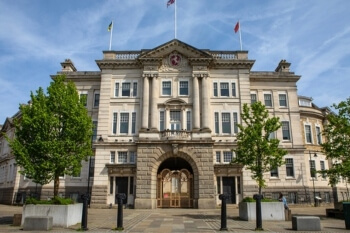
Mobilityways' local authorities lead Graeme Banister asks: should councils reinvent their town halls, or motivate staff to return and fill up these empty edifices?
An April 2023 study which gained responses from more than 200 councils across the UK, a full year on from the last Covid-19-related restrictions being lifted, found that over half (58%) of their workers were still spending two or fewer days in the office each week.
This broke down as follows: two fifths (38%) said their staff were in the office two days per week, and a further fifth (19%) were working in council offices just one day per week. Just 6% of council employees were back working full time in their council offices more than a year after pandemic restrictions were fully lifted nationwide!
In view of this massive change in working patterns, is it time that councils ‘right-sized’ their council offices, possibly involving the sale of some of the large town council buildings across the UK and/or sub-letting of some underutilised parts of town halls?
Many councils in financial distress
These decisions are likely to be all the more urgent as clear evidence emerges of the financial distress of up to a third of councils across England. According to the Special Interest Group of Municipal Authorities (Sigoma) at least 26 councils are considering declaring bankruptcy within the next two years and a further 12 councils are considering issuing their Section 114 notices during the current fiscal year 2023/4.
Sigoma is not alone in painting a grim picture of councils’ books. The National Audit Office recently reported that 25 of the 339 local council of England are at high or acute risk of running out of money within the next year and the LGA estimates that the sector faces a funding gap of almost £3bn over the next two years.
Toxic trio of factors hitting income of councils
Of the five councils that have already issued Section 114 notices since 2021, three of them (Thurrock, Woking and Croydon) have been impacted by falling property prices having invested heavily in commercial properties to generate additional income which evaporated as the market turned downwards during the pandemic.
Analysis by the likes of Moody’s suggests that a failure of scrutiny of the spending and investment portfolios of councils since 2015, combined with a 17.5% real-terms cut in central government funding between 2010 and 2020 and HM Treasury’s offer of very low interest rate loans to councils under the HM Treasury Public Works Loan Board (PWLB) funding, have together proved a toxic mixture.
Many local authorities were highly active in use of PWLB funding to acquire commercial property as central government funding fell away. It is estimated that in the fiscal year 2019-20 alone, £1.6bn of the £10.1bn lent to local councils by the PWLB was for ‘debt-for-yield’ activity (defined as borrowing to invest in commercial property primarily for income generation).
It now seems certain that we are heading into yet another period of fiscal tightening for councils, which must place greater scrutiny on large town halls and council headquarters as well as on the office blocks, leisure parks, and even hotels that have been bought by councils to generate additional income streams over the last 13 years.
Opportunity for leadership on Net Zero
The right-sizing of council offices must be seen against the backdrop of the climate emergency that many councils have already declared. Reducing office space to bring it in line with the number of desks that are actually needed for local government workers will definitely contribute to reductions in carbon emissions that councils will be able to report.
After all, councils that can exhibit leadership in emissions reduction and estate right-sizing will have the moral authority to stimulate their local businesses to do the same. So, council leaders need to ask themselves the question: what is the strategic plan for their council headquarters or town hall?
Will they need to be sold off, or sublet to other organs of state or private businesses? Or perhaps ‘sold and leased back’ agreements need to be struck to free up hard-pressed budgets now that cheap money is no longer available to buy commercial property and building occupancy levels which they were normal pre-pandemic seem unlikely to ever return.
At the very least, councils need to be seen to lead the regions they are running in terms of helping their employees find less carbon intensive ways to get to work. Keeping large empty spaces in cavernous town halls well heated and lit is not a good look when, as many councils have already declared, there is a growing body of evidence of a climate emergency.