 In last week’s budget, chancellor George Osborne declared that he would continue the ‘devolution revolution’, with new powers going to Greater Lincolnshire, the West of England and East Anglia. And at the vanguard of this revolution is Greater Manchester. Having already been granted control of a £6bn health and social care budget and control over the work programme, this fourth devolution agreement announced last week sees further commitments, including a new Life Chances Fund to invest in innovative approaches to public services, and greater control over adult skills and housing.
Greater Manchester has now committed to another revolution – to create an age friendly city region. In partnership with the Centre for Ageing Better, the combined leadership of Greater Manchester will expand the benefits afforded by the City of Manchester’s status as an age friendly city to all those living in the wider city region, positively impacting an additional 2.2 million people.
Over the next five years we will work together to ensure that more people across the region will enjoy a good later life: tackling inequalities in health, social and economic prospects of people across the region.
Ageing Better will capture evidence about what works to help ensure a good later life, and will work through the Greater Manchester Ageing Hub to apply this to drive improvements across Greater Manchester, and share our learning across England.
Most parts of England are undergoing a profound shift in their demographics as more people are living longer, as the baby boomers age and as the birth rate falls. Many local areas see this as a challenge and focus on the pressures on public services and budgets, particularly as it relates to social care. Some local areas though have acknowledged these changes and are ambitious about the opportunity of creating age friendly communities, where the contribution of people in later life is valued and encouraged.
We support the World Health Organization’s vision of an ‘age friendly world’. One in which people of all ages actively participate in their community, it is easy for people to stay connected, for people to stay healthy and active and appropriate support is available to those who need it.
There are a number of great examples where innovations are being adopted. In Nottingham, local businesses are supporting the ‘take a seat’ initiative to provide people with somewhere to stop and rest when they are out and about. In the Isle of Wight they are creating age friendly GP surgeries and providing tailored employment support for the over 50s. Sadly, there are also plenty of examples where much work needs to be done. On a recent trip to Leeds, I visited one neighbourhood that despite being only 15 minutes walk for a fit person from the city centre is completely cut off with little reason for anyone to go in or out of the area.
Long term partnerships with localities are essential if Ageing Better is to have impact at a societal level. We will work with places to deliver significant and sustained impacts over time across all dimensions that enable people to enjoy a good later life – health, financial security and social connections.
Too many people still miss out on a good later life and many more people are at risk of a poor quality of later life if things don’t change. We believe that local government has a significant leadership role to play on this issue and by mobilizing the public and private sector, employers, businesses and the voluntary and community sector it can ensure that the opportunities of an ageing population are seized and the challenges faced.
Working with Greater Manchester is the first of our locality partners. We are looking to partner with more localities (both urban and rural) that share our ambition to create a society in which everyone enjoys a good later life, that share our commitment to evidence, and that have a track record of delivering innovation and change at scale. The Centre for Ageing Better will work with and support these areas to systematically apply evidence, learn from each other and develop and test innovative new approaches.
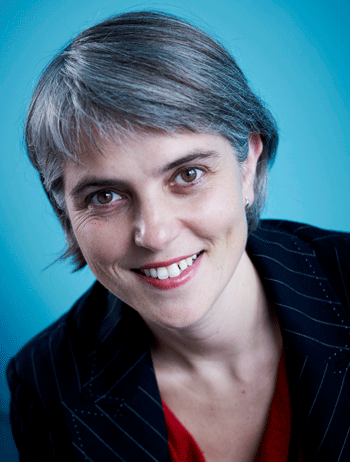
Anna Dixon is CEO of the Centre for Ageing Better