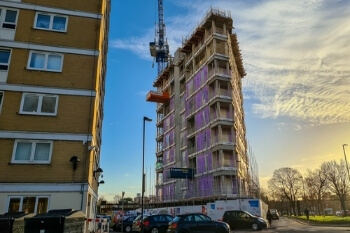
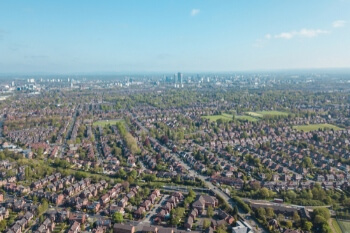
Britain's largest cities are being held back economically by sprawling low-rise neighbourhoods built in the post-war decades, a leading think tank has warned.
New analysis from Centre for Cities found that low-density developments built between 1950 and 1996 account for nearly half of all housing within one to two kilometres of the centres of Manchester, Birmingham, Glasgow, Liverpool and Leeds.
The report estimates these post-war developments are typically 40% less dense than pre-war housing in comparable locations — a gap the organisation says is suppressing productivity and limiting access to jobs.
Compared to similar-sized cities in France and Japan, the density shortfall across UK cities is equivalent to 2.3 million homes, with large cities like Manchester and Birmingham accounting for more than half of that figure.
Centre for Cities is calling for planning reforms, changes to the National Planning Policy Framework, and investment through a new City Densification Fund to help metro mayors drive large-scale urban regeneration and unlock the full economic potential of Britain's major cities.
Ant Breach, director of Policy and Research at Centre for Cities, said: ‘Government is right to make a plan to densify large cities. Neighbourhoods close to city centres need more homes – including a mix of new flats and houses – to support urban living, transport investment and economic growth.
‘Denser cities have larger labour markets and higher productivity potential. Redeveloping low-density neighbourhoods in big cities like Manchester, Birmingham and Leeds would add new homes with access to good jobs and opportunities those cities generate.’